Foot strength and balance are connected, but strong toes are not a complete fall-prevention plan. The small muscles inside the feet help support the arch, adjust to the ground, and contribute to sensory feedback. The larger muscles around the ankle help control push-off and keep the body steady when weight shifts.
Research suggests that foot and ankle exercises can improve some measures of strength, flexibility, and balance in older adults. Evidence that they directly prevent falls is much less certain. The most useful approach is to include the feet within a broader program that also trains the legs, hips, balance, walking ability, and confidence.
Why feet matter more with age
Every step requires the foot to be both flexible and stable. It absorbs force, adapts to the surface, then becomes a lever that helps move the body forward. Toes contribute to balance and propulsion, while the ankle responds when the body sways.
With age, muscle strength, joint mobility, vision, sensation, and reaction speed may change. Foot pain, bunions, toe deformities, arthritis, poorly fitting shoes, and peripheral neuropathy can further alter walking. These factors do not automatically lead to a fall, but they can reduce the margin for recovering from a trip or uneven surface.
What research on foot exercises shows
A 2022 systematic review examined intrinsic foot-muscle strengthening in adults age 65 and older. Nine studies met the criteria. The interventions contributed to improvements in strength, balance, mobility, and possibly fall risk, but the evidence was only fair quality and methods differed too much for a pooled statistical result.
A 2025 systematic review and meta-analysis included 16 papers and 651 older adults. Foot and ankle exercises produced small improvements in plantar-flexion strength, flexibility, and balance with the eyes open. They did not clearly improve gait speed, balance with the eyes closed, fear of falling, or the number of falls. The certainty of evidence ranged from very low to low.
That distinction matters. A better balance-test score is encouraging, but it does not prove that one exercise prevents fractures or preserves independence. Foot work is best treated as a useful component, not a protective guarantee.
Five gentle exercises to consider
Use a sturdy chair or counter for support. Movements should feel controlled rather than painful. Begin with a small range and a few repetitions, especially after inactivity.
1. Toe press and release
Sit with both feet flat. Gently press the toes into the floor without curling them tightly or lifting the heel. Hold for several seconds, relax, and repeat. Think of widening the toes and making calm contact with the ground.
2. Short-foot exercise
While seated, keep the heel and toes on the floor. Gently draw the ball of the big toe toward the heel so the arch shortens slightly. Avoid gripping with the toes. The movement is small and may take practice.
3. Heel raises
Stand behind a chair, rise slowly onto the balls of the feet, then lower with control. Use both hands as needed. Progress by reducing hand support only when the movement is steady and pain-free.
4. Toe raises
With heels on the floor, lift the front of the feet and toes, then lower slowly. This trains muscles involved in clearing the foot during walking. Hold support and avoid leaning backward.
5. Supported weight shifts
Stand with feet comfortably apart and a counter nearby. Shift weight gently from side to side, noticing pressure move across each foot. Progress to forward and backward shifts without lifting the feet.
Balance training needs more than foot strength
Feet are one part of a larger movement system. For a whole-body companion, see muscle strength and healthy aging.
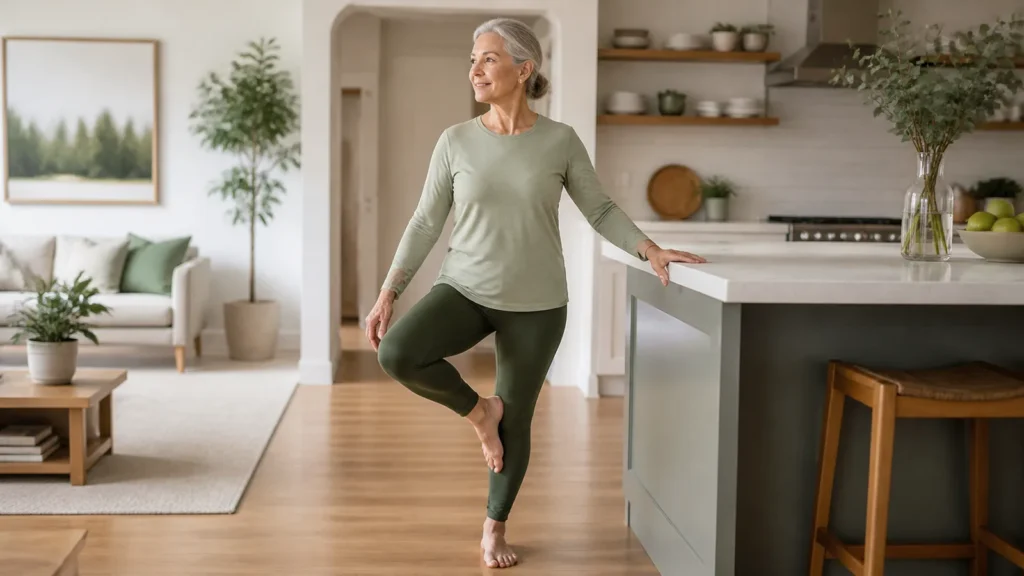
The National Institute on Aging recommends balance activities such as standing on one foot, heel-to-toe walking, sideways walking, backward walking, chair stands, tai chi, and appropriate yoga. These challenge the coordination of vision, the inner ear, sensation, and the whole musculoskeletal system.
Leg and hip strength are equally important. Rising from a chair, climbing steps, changing direction, and catching the body after a stumble require more than the toes. A physical therapist can combine foot exercises with progressive strength and balance work at the right difficulty.
Footwear is part of the system
The CDC identifies foot pain, reduced ankle flexibility, reduced calf strength, neuropathy, bunions, and toe deformities as fall-related factors. Shoes should fit securely, have traction, and provide a stable base. Slippers without heel support, socks on smooth floors, and shoes that are too long or loose can make walking less predictable.
Minimal or barefoot training is not automatically superior. Some people enjoy it and tolerate it well; others need protection, cushioning, or support because of pain, diabetes, reduced sensation, deformity, or previous injury. The safest choice is individual.
When to seek professional guidance
See a clinician, podiatrist, or physical therapist for persistent foot pain, swelling, wounds, sudden weakness, frequent tripping, new numbness, or a change in walking. People with diabetes should not ignore blisters, calluses, color changes, or broken skin.
A fall, near-fall, or new fear of falling also deserves attention. Medicine side effects, low blood pressure, vision problems, hearing changes, home hazards, and neurological conditions may contribute. Exercises alone cannot correct every cause.
A simple weekly approach
- Practice foot and ankle exercises two or three times weekly.
- Include whole-leg strength work on at least two days when appropriate.
- Add balance practice near a stable support.
- Walk or perform another aerobic activity suited to your ability.
- Review footwear, vision, medicines, and home hazards if fall risk is a concern.
Progress should be gradual. More difficult is not always more effective, especially when fatigue makes the movement less controlled.
The Healthspan Muse perspective
Feet are easy to overlook until they hurt or feel unreliable. A few minutes of thoughtful foot and ankle work can improve awareness, strength, and confidence. The evidence supports including these exercises, while reminding us not to promise that toe curls alone prevent falls.
Train from the ground up, but keep the whole person in the plan: feet, legs, balance, vision, medicines, environment, and the confidence to keep moving.
Sources & further reading
- Intrinsic foot-muscle strengthening and mobility in older adults: systematic review
- Ankle and foot exercises, strength, balance, and falls: systematic review and meta-analysis
- Foot and ankle programs and fall-related outcomes: systematic review
- National Institute on Aging: Strength, Balance, and Flexibility Exercise
- CDC: Preventing Falls and Hip Fractures
This article is for general educational purposes and is not a substitute for personalized medical advice, diagnosis, physical therapy, or treatment.