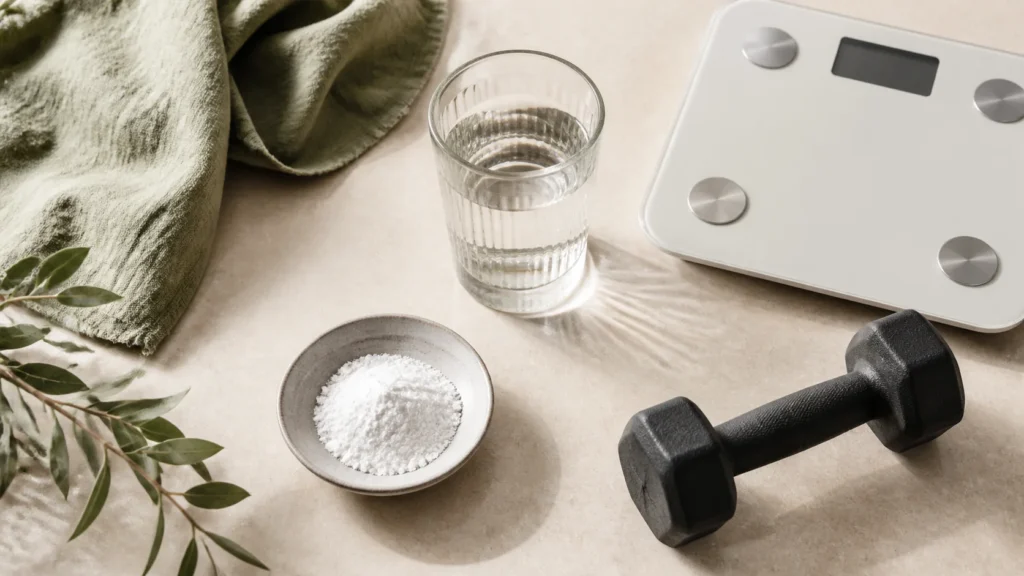
Creatine can cause a modest increase in scale weight, particularly during the first days of a loading phase. That statement is true—but the internet often leaves out the most important detail: the early change is generally related to water stored with creatine inside muscle, not a sudden increase in body fat.
What to keep in mind
Early scale change after creatine is not the same as body-fat gain, and individual responses vary. Loading can change the timing of the increase, while a steady daily approach fills stores more gradually. Judge the decision alongside comfort, training goals, and medical context. Unusual swelling, breathing symptoms, or a concerning clinical change requires assessment rather than an assumption that the supplement explains everything.
For someone focused on weight loss, even a small upward shift can feel discouraging. Understanding what the number represents makes it easier to decide whether creatine fits your goals.
Why Creatine Can Increase Water Weight
Creatine helps the body rapidly regenerate adenosine triphosphate, or ATP, during brief, intense activity. Most of the body’s creatine is stored in skeletal muscle. As muscle creatine stores rise, water is drawn into the muscle cell.
This is called intracellular water. It is not the same thing as visible puffiness under the skin or swelling in the feet and ankles. Some people describe their muscles as looking slightly fuller; others notice nothing except a scale change.
How Much Weight Gain Is Typical?
There is no exact amount that applies to everyone. Studies using a loading protocol—commonly about 20 grams daily divided into several doses for five to seven days—often report a short-term rise in body mass. The response depends on baseline muscle creatine, muscle mass, diet, dose, and individual biology.
A loading phase is optional. Taking 3–5 grams of creatine monohydrate daily can also increase muscle creatine stores, only more gradually. This slower approach may make any change on the scale less abrupt and is often easier on the stomach.
Is Creatine Weight Gain Fat?
Creatine itself does not contain meaningful calories and does not directly create body fat. Gaining fat requires a sustained energy surplus. An early increase after starting creatine is therefore much more likely to reflect water and normal day-to-day fluctuation than new fat tissue.
Over time, creatine may help people train more effectively. When combined with progressive resistance exercise, that can support gains in lean tissue. New muscle also has mass, so the scale may not fully capture a favorable change in body composition.
Does Creatine Cause Bloating?
Some people use “bloating” to describe any weight increase, but digestive bloating and muscle water are different experiences. Large single doses can cause stomach discomfort, loose stools, or a distended feeling in some users. Dividing a loading dose—or skipping loading altogether—may improve tolerance.
Research reviews do not support the idea that standard long-term creatine use inevitably causes harmful, generalized water retention. Still, personal experience varies. If a supplement repeatedly makes you feel unwell, there is no prize for pushing through it.
How to Reduce the Scale Surprise
- Skip loading: Use a consistent 3–5 gram daily approach instead of taking large doses for a week.
- Choose creatine monohydrate: It is the most studied form; expensive “non-bloating” versions do not erase normal physiology.
- Weigh consistently: Compare morning weights under similar conditions and watch the weekly trend rather than a single reading.
- Track useful outcomes: Strength, repetitions, walking speed, waist measurement, energy in training, and clothing fit add context.
- Keep the rest of your routine stable: Starting creatine while dramatically changing carbohydrate and sodium intake makes the scale harder to interpret.
Should You Stop Creatine If Your Weight Goes Up?
Not automatically. If the change is modest, you feel well, and improved strength or training quality matters to you, intracellular water may be an acceptable tradeoff. If seeing a higher number worsens anxiety or interferes with eating-disorder recovery, the supplement may not be worth the psychological cost.
You can stop creatine if you choose. Muscle creatine stores and the associated water generally decline gradually after discontinuation; they do not disappear overnight.
Creatine, Kidneys, and Lab Tests
In generally healthy adults, recommended doses of creatine monohydrate have a strong safety record in the research literature. However, creatine can affect serum creatinine, a breakdown product used in common kidney-function estimates. A higher creatinine result does not automatically prove kidney damage, but it can complicate interpretation.
Tell your clinician that you take creatine before kidney testing. People with known kidney disease, significant medical conditions, pregnancy, or medications that affect kidney function should seek individualized advice before starting any supplement.
When “Water Retention” Needs Medical Attention
Expected muscle water should not cause shortness of breath, one-sided leg swelling, rapidly worsening ankle or facial swelling, chest pain, or a severe reduction in urination. Those symptoms should not be blamed on a fitness supplement; seek prompt medical care.
Frequently Asked Questions
Will creatine make my face look puffy?
That is not an expected or well-established effect of standard dosing. Noticeable facial swelling—especially with breathing problems, hives, or lip and tongue swelling—needs urgent medical assessment.
Can I take creatine while trying to lose fat?
Many people do. Creatine does not prevent fat loss, though its water-related scale effect can temporarily mask progress. Use measurements beyond body weight.
Do women retain more water from creatine?
Current evidence does not support a simple rule that women experience greater harmful water retention. Response varies, and research in women remains less extensive than research in men.
Use a repeatable measurement routine
If you choose to monitor weight, compare measurements taken under broadly similar conditions rather than reacting to readings taken at different times of day. Meals, hydration, menstrual changes, bowel contents, and recent training can influence the scale independently of fat change. A short-term increase after starting creatine does not establish which of those factors contributed or justify an immediate reduction in food.
Pair the number with function: training performance, comfort, recovery, and how the supplement fits your goals. Avoid weighing more frequently if that increases anxiety or restrictive eating. People recovering from an eating disorder may be better served by discussing supplement decisions without routine scale monitoring. The most informative outcome is not always the easiest number to collect.
If swelling is visible, persistent, one-sided, painful, or accompanied by breathing difficulty, do not explain it away as ordinary creatine water weight. Seek appropriate assessment. A familiar supplement name should never become a reason to overlook a new symptom or an unrelated medical condition.
The Bottom Line
Creatine-related weight gain is usually water held within muscle, not body fat. Loading makes the change faster; a steady daily dose fills stores more gradually. Judge the supplement by your full set of goals—strength, function, training quality, comfort, and medical context—not one isolated scale reading.
For a related practical guide, read Creatine for Women Over 40: Benefits, Safety, and Dosage.
Sources
- Common questions and misconceptions about creatine supplementation (2021 review)
- Creatine monohydrate supplementation on body weight and percent body fat
- Creatine supplementation in women’s health: a lifespan perspective
This article is for educational purposes and does not replace individualized medical advice.