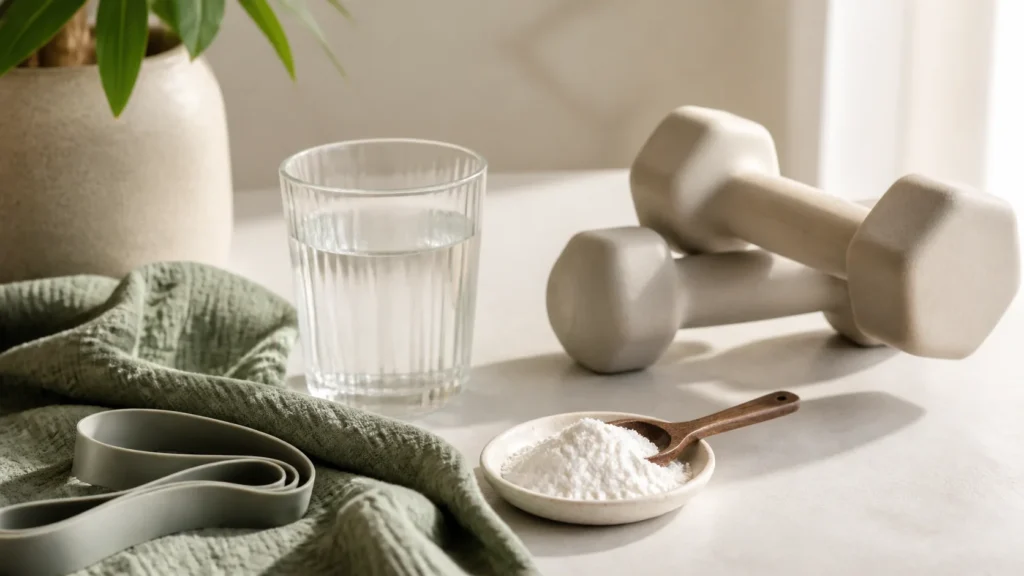
Creatine for women over 40 has moved from the weight-room corner into a much broader conversation about strength, healthy aging, and menopause. The attention is not entirely hype. Creatine is one of the most studied sports supplements, and emerging research in women suggests that it may be useful well beyond competitive athletics.
What to keep in mind
Creatine is an optional addition to a foundation of training and adequate nutrition. Benefits depend on the outcome being discussed, and evidence for strength should not be transferred automatically to menopause symptoms or brain health. Review product quality and medical context, particularly kidney disease or complex treatment. A scale increase may reflect water rather than fat, but new concerning symptoms still need evaluation.
Still, creatine is not a hormone treatment, a shortcut to muscle, or a guaranteed brain-health supplement. Its clearest benefit is helping muscles rapidly recycle energy during repeated, demanding efforts. That can make strength training more productive over time.
What Is Creatine?
Creatine is a compound made from amino acids. Your body produces it, and foods such as meat and fish provide smaller amounts. Most creatine is stored in skeletal muscle as creatine and phosphocreatine, where it helps regenerate adenosine triphosphate—the energy currency used during short, intense activity.
Supplementing increases muscle creatine stores in many people. The result is not instant muscle growth. It is a slightly larger energy reserve that may help you complete an extra repetition, maintain training quality, or recover between hard efforts. Repeated over weeks and months, better training can support gains in strength and lean mass.
Why Women Over 40 Are Interested
Midlife can bring changes in sleep, recovery, body composition, and physical activity. The menopause transition also coincides with an age when preserving muscle and bone becomes increasingly important.
Creatine cannot reverse menopause. It may, however, complement the intervention that matters most for muscle: progressive resistance training. A 2026 systematic review of seven randomized trials involving 608 postmenopausal women found small average improvements in lean mass and leg-press strength. Benefits were most apparent alongside resistance training; bone density did not clearly improve overall. Evidence in perimenopausal women remains thinner, and not every trial finds the same result.
Potential Benefits
Strength and training capacity
This is the most established use. Creatine can improve performance during repeated high-intensity efforts and may enhance strength-training adaptations. The practical benefit is usually modest, not cinematic. You still have to train.
Lean mass
Creatine paired with resistance exercise may support a small additional increase in lean mass. Some early scale weight can reflect water moving into muscle cells rather than new muscle or body fat.
Cognition
The brain also uses creatine. Studies are exploring possible cognitive benefits, particularly during sleep deprivation, stress, aging, or low dietary creatine intake. The findings are promising in selected settings but not strong enough to describe creatine as a reliable memory treatment.
Bone health
Creatine is sometimes marketed for stronger bones. Any benefit may come indirectly through better muscle function and training. Trials have produced mixed results, so creatine should not replace adequate nutrition, resistance and impact exercise when appropriate, or medical osteoporosis care.
Water Weight: The Short Answer
It can increase scale weight, especially during a loading phase. The early change is generally linked to water retained inside muscle, not fat gain. Some people notice little change; others see a pound or two.
This intracellular water is not the same as suddenly accumulating body fat. If daily scale changes feel stressful, track strength, waist measurements, how clothes fit, and longer-term trends rather than treating one morning number as a verdict.
Will It Make Women Bulky?
No supplement can create large muscles without the training volume, nutrition, genetics, and time required to build them. Creatine may help a woman gain strength and some lean mass with training. That is usually the point—not an accidental transformation into a competitive bodybuilder.
How Much Creatine Is Commonly Used?
A widely used maintenance approach is 3 to 5 grams of creatine monohydrate daily. A loading phase—often divided doses totaling about 20 grams daily for five to seven days—fills stores faster but is not required. Taking a smaller daily amount can reach the same destination more gradually and may be easier on the stomach.
Consistency matters more than timing. Take it at a time you can remember, with enough fluid. Mixing it with a meal or shake is perfectly reasonable.
Creatine monohydrate is the best-studied form. More expensive forms have not consistently proved superior.
Safety and Side Effects
Creatine monohydrate is generally well tolerated by healthy adults at customary doses. Possible issues include temporary weight gain, stomach discomfort, or diarrhea—particularly with large single doses.
Creatine can raise blood creatinine, a breakdown product used in kidney-function estimates. That laboratory change does not automatically mean kidney damage, but it can complicate interpretation. Tell your clinician and laboratory team that you take creatine.
People with kidney disease, significant liver disease, pregnancy, breastfeeding, complex medical conditions, or medications that affect kidney function should seek individualized advice before using it. Supplement quality also varies; choose a product with independent third-party testing.
A Practical Starting Plan
- Choose plain creatine monohydrate from a third-party-tested brand.
- Discuss whether a maintenance dose within the commonly studied 3–5 gram daily range is appropriate for your health and training plan.
- Skip loading if rapid scale changes or stomach upset would bother you.
- Pair creatine with a progressive full-body strength program.
- Eat adequate protein and total energy; powder cannot replace meals.
- Reassess strength and tolerance after eight to twelve weeks.
Frequently Asked Questions
Can I take creatine without working out?
You can, but its most reliable physical benefits appear when it supports resistance training or repeated high-intensity activity.
Does creatine affect hormones?
Creatine is not estrogen, progesterone, or testosterone. It should not be promoted as hormone replacement.
Should I cycle it?
Routine cycling has not been shown to be necessary. Some people stop because they no longer want it, not because the body requires a scheduled break.
What if I do not eat meat?
Vegetarians and vegans often consume less dietary creatine and may experience a larger increase in muscle stores with supplementation, although individual responses vary.
The Bottom Line
Creatine monohydrate is not reserved for young men in gyms. For women over 40, it can be a practical companion to strength training and may offer small benefits for strength and lean mass. Claims about menopause symptoms, bones, and brain health remain more tentative.
Use a well-tested product, keep the dose simple, and judge it by what your body can do—not by marketing promises or a single scale reading.
Creatine is an optional companion to training. Start with the movement foundation in our two-day strength-training plan for women over 40.
Explore more guidance in our Hormones & Midlife collection.
Sources
- Creatine in women’s health: bridging the gap from menstruation through pregnancy and menopause
- Creatine monohydrate for lean mass, strength, and bone outcomes in postmenopausal women
- Common questions and misconceptions about creatine supplementation
- NIH Office of Dietary Supplements: Exercise and athletic performance supplements
This article is educational and is not a substitute for individualized medical, nutrition, or exercise advice.