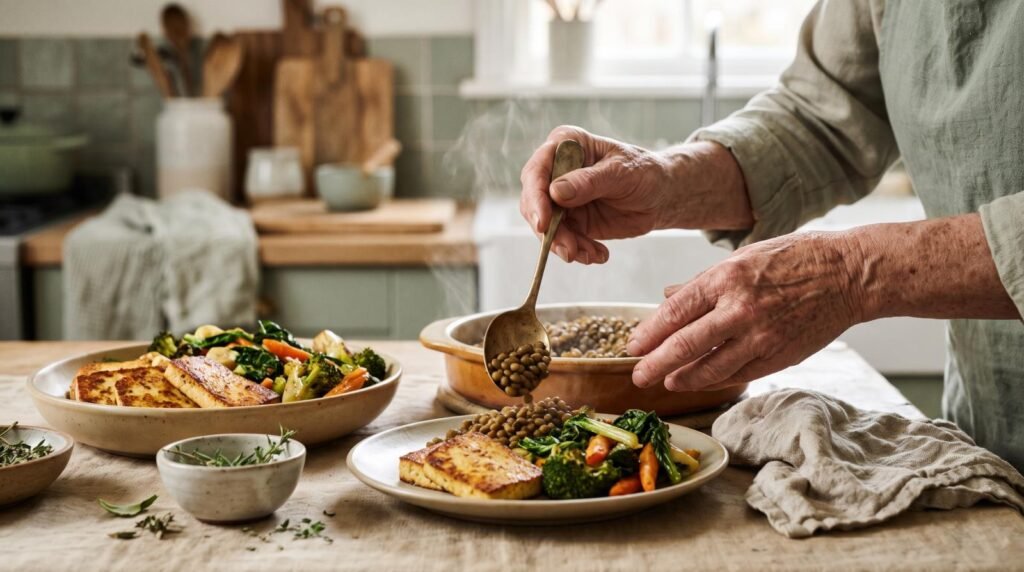
Verdict: Supported for the specific trial, but too broad as a verdict on vegan diets. In a 12 week randomized study of healthy adults age 65 and older, people assigned to a self chosen vegan diet ate less protein and lost more measured muscle mass than people who stayed with their usual omnivorous diet. A vegan diet paired with supervised resistance exercise reduced the size of that difference. The study did not test a vegan diet designed to keep protein and energy intake equal to baseline, so it cannot show that plant based eating itself inevitably causes muscle loss.
What the researchers compared
The trial enrolled 72 healthy, community dwelling adults age 65 or older. Participants were randomly assigned to three groups: continue their habitual omnivorous diet; switch to a self composed vegan diet; or follow a self composed vegan diet while completing supervised resistance exercise twice a week. The intervention lasted 12 weeks. The vegan groups received nutrition information meetings, but the researchers did not provide every meal or prescribe a protein matched menu.
That distinction is central to the result. The trial asked what happened when older adults made a real dietary change and chose their own foods. It did not isolate the effect of animal versus plant protein while holding total protein, calories, and meal structure constant.
What changed in the vegan groups
Compared with their starting intake, participants in the vegan only group consumed about 28 grams less protein per day in week one and about 19 grams less per day in week 12. The vegan group with exercise also reduced protein intake. Intake stayed broadly stable in the omnivorous group.
Researchers measured thigh muscle volume with MRI and appendicular lean mass with DXA, a body composition scan. After 12 weeks, thigh muscle volume in the vegan only group had fallen by about 0.61 liters and appendicular lean mass by about 1.15 kilograms. The corresponding changes in the omnivorous group were close to zero. These are measurements of muscle related tissue, not proof that participants became unable to do daily activities or experienced a lasting health problem.
The team also assessed muscle protein synthesis, the process by which the body builds muscle proteins. During the first ten days, the estimated rate was lower in the vegan only group than in the omnivorous group and the vegan plus exercise group. This helps describe a possible biological pathway, but it is a short term measurement and does not by itself predict long term strength, independence, or disease risk.
Resistance exercise reduced the loss
The group that combined a vegan diet with supervised resistance exercise also lost some measured muscle tissue, but the change was smaller than in the vegan only group. Its thigh muscle volume fell by about 0.35 liters and appendicular lean mass by about 0.62 kilograms. That pattern supports the idea that muscle use matters during a dietary transition. It does not mean exercise erased every difference from the usual diet group.
The exercise program was supervised and took place twice weekly. The study therefore gives more information about that structured program than about casual activity, walking alone, or an unsupervised routine. The trial also measured muscle strength, but the clearest reported differences in its abstract concern muscle mass and protein synthesis.
Why this is not a verdict on every vegan diet
Protein intake dropped as participants changed what they ate. The study therefore cannot separate the effect of choosing vegan foods from the effect of eating less protein overall. It also does not answer what would happen if people deliberately replaced the protein they had removed, selected a varied range of plant protein foods, and maintained adequate energy intake.
A different randomized study illustrates why the comparison matters. In 34 physically active older adults, researchers provided short, controlled vegan and omnivorous diets with similar energy and protein. Over ten days, muscle protein synthesis did not significantly differ between diets. That small, brief study cannot settle long term muscle outcomes either. Together, the trials suggest that the amount and structure of the diet, the participants, and the follow up period all matter when interpreting a broad headline.
Limits and open questions
This was a 12 week study with 72 participants, and it involved healthy older adults who had previously eaten animal foods regularly. The findings may not apply to younger adults, people living with chronic illness, established vegans, or people who carefully plan a higher protein vegan diet. The study was not long enough to establish whether the measured changes persist, reverse, or affect mobility and everyday function.
The authors report that some investigators have received research grants, consulting fees, or speaking honoraria for work on muscle metabolism, including support connected to companies producing protein foods. The disclosure says these organizations did not influence this trial’s design or outcomes. That context is useful when reading nutrition research, while the reported study methods and results still need to be assessed on their own.
The practical research question is not whether one diet label is universally better. It is whether older adults can meet their nutritional needs while changing their eating pattern, and which combinations of food planning and resistance exercise best support muscle over time. This trial raises that question; it does not answer it for every person or every version of a vegan diet.
What a food swap can hide
Picture two lunches built around the same grain bowl. In one, the cook removes the usual protein ingredient and adds more vegetables. In the other, the cook replaces that ingredient with a substantial serving of beans or tofu. Both lunches can be vegan, but the change in protein can look quite different. The trial tracked what people chose across their whole diet, so its averages describe the transition those volunteers made. A trial built around deliberate, comparable substitutions would answer a different question.
There is also a difference between preserving tissue on a scan and preserving the ability to carry groceries or climb stairs. A longer study could track both alongside food intake. That would help show whether an early change in muscle volume persists and whether its size matters in everyday life.
Sources
- Original 12 week randomized trial, American Journal of Clinical Nutrition
- ClinicalTrials.gov registration, NCT05809466
- Controlled protein matched trial in active older adults
This article is educational and does not replace individualized medical or nutrition advice.
Related reading: High-Protein Breakfasts for Healthy Aging