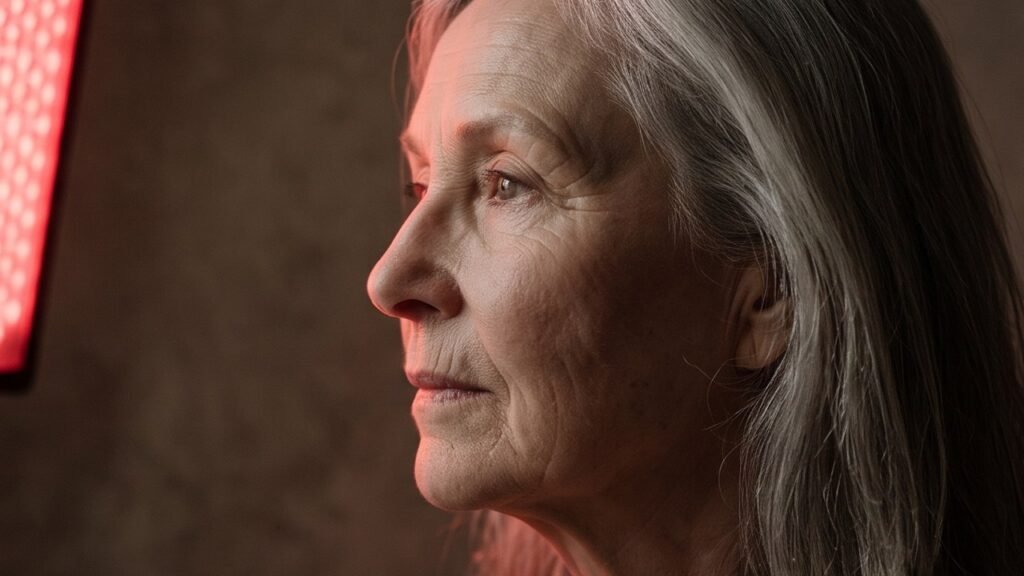
Can red light soften facial wrinkles? A controlled human study supports a modest version of that claim. Researchers measured changes in skin texture under specific light treatments. The experiment tells us very little about whether light can slow aging elsewhere in the body.
Here’s the clever part. People have different skin, different sun exposure histories and different ideas about whether a wrinkle looks better. So the investigators treated one side of each participant’s face. The other side offered a comparison close enough to share the same birthday.
In this 2007 trial, the team recruited 112 adults aged 35 to 55 and assigned them to four groups; 76 completed the study. The groups received red light at 633 nanometers, near infrared light at 830 nanometers, a combination of the two, or a sham treatment. Sessions took place twice a week for four weeks, with follow-up for three months. Researchers measured skin texture and elasticity. The largest reported average wrinkle reduction was 36% from baseline, in the combination group at the three month assessment.
That number deserves a careful read. A change in an instrument’s roughness reading is quite specific. It cannot tell you that a face looks 36% younger. And when 36 of 112 people do not finish a study, it is worth asking whether the people who stayed tell the whole story.
Why one face makes a useful comparison
Two people can arrive at a skin study with very different histories of sun exposure. One has spent years working outside. The other has spent most workdays indoors. They may already differ in the depth of their lines or the way their skin responds to a treatment. Using the two sides of the same face helps researchers hold some of that history steady. They still need to make sure they are comparing similar areas, and they need a way to tell whether a change is bigger than the variation they see from one measurement to the next.
The untreated side also does not start as a perfect mirror. Someone who drives frequently can expose one side to a different amount of sunlight. A person may have deeper lines on one cheek to begin with. Measuring both sides at the start gives researchers a record of those differences. The sham group adds another useful comparison because the experience of participating in a skin study could change how someone looks after their skin or how closely they look for results. The experimental design gives us more to work with than two photographs of a person before and after a mask.
Where the 36 percent lives
Skin roughness here was a particular measurement of the surface. The researchers could report how much it changed compared with the starting value. That percentage depends on what the instrument measures and which people and time point are being described. It belongs to the combination group at the follow-up visit described above. It does not describe the result for red light alone, or what every participant would see in a bathroom mirror.
An instrument can detect a subtle change in texture under controlled conditions. Someone examining their face in a photograph may notice a different feature first, such as a deep line, a change in color, or the way light falls across a cheek. That does not make the instrument reading unimportant. It gives the two observations different jobs. If a treatment is sold on a claim about visible improvement, the most relevant study would also tell us how many people noticed a difference, how large they considered it, and whether someone assessing photographs without knowing who received treatment saw a similar pattern.
Who was still there at the last visit?
The study recorded results from 76 participants who completed it. The 36 who did not finish are important when interpreting the estimate. If people leave a study for reasons unrelated to the treatment, the results among those who stay can still be informative. If leaving is related to the experience or the results people are seeing, the averages can shift. A reader cannot assign a motive or outcome to everyone who left. The missing information is one reason to avoid presenting the largest percentage as an expectation for anyone who tries the treatment.
The timing of the last visit matters for a different reason. A three month observation after treatment gives the researchers some ability to see what happens after the sessions end. It cannot show whether a change would still be there after a year or whether the same effect can be sustained with repeated use. An experiment with longer follow-up would help a person weigh how long the likely benefit lasts against the effort and expense of the treatment.
What to look for in a device claim
The investigators distinguished red light from near infrared light and tested them both separately and in combination. The wavelength matters, as do how much light reaches the skin and how long it is delivered. Two products can look alike in a photograph and deliver different exposure. A study of one device and schedule is evidence about that setup. If a home mask advertises the study’s largest percentage, a useful question is whether anyone measured a comparable outcome with the mask being sold.
Safety belongs to the same comparison. Participants in one small trial reported no adverse effects. That does not reveal how every device behaves near the eyes or how someone with a particular skin condition might respond. The device’s own evidence and instructions are the relevant starting point for those questions. I would keep the smallest promise visible here: under the tested conditions, the researchers could measure a change in the texture of treated skin. How a different device would look and feel to the person wearing it is the next question.
For someone considering a home mask, the useful question is whether that particular device has been tested for the result they want. Color alone tells you little about the light that actually reaches the skin. The investigators reported no adverse effects in this trial. A reader comparing masks still needs the safety information for the device they would actually wear.
Original trial at the journal · Publication record
Related reading: What Your Skin Can—and Cannot—Reveal About Your Health