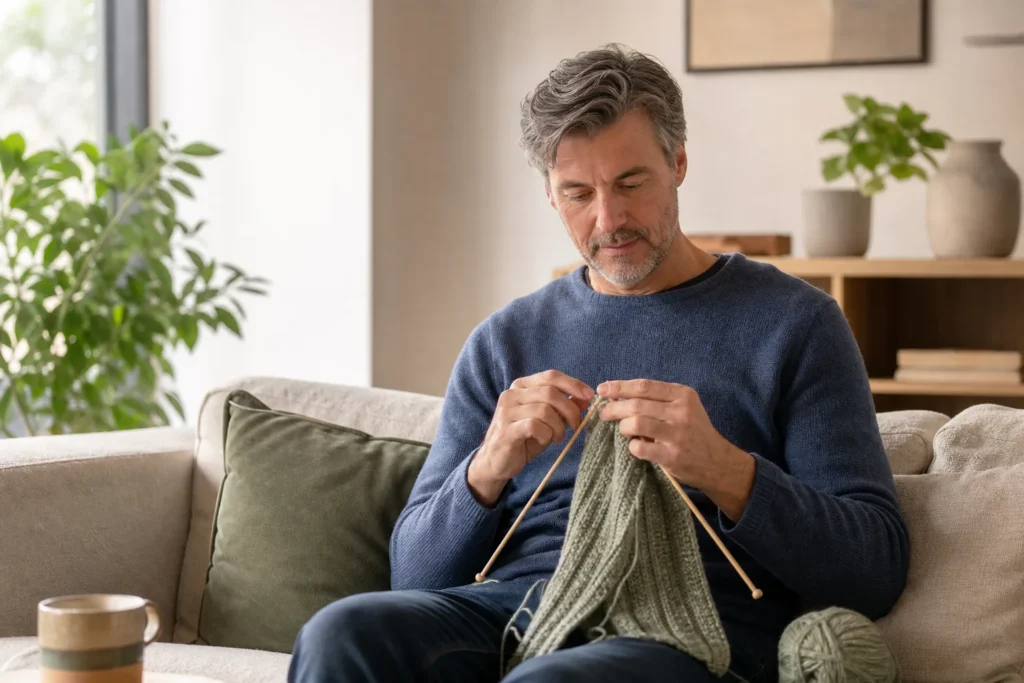
Knitting for stress relief has an appealing rhythm: hands move, yarn becomes something tangible, and attention settles on the next stitch instead of the next notification. For many people, that combination feels calming. But can a creative hobby meaningfully support well-being—and does knitting deserve to be called a longevity habit?
What to keep in mind
Crafts research often measures wellbeing over a limited period and includes varied activities. It does not establish that knitting prevents dementia or extends life. Choose a small project you enjoy, adapt for hand or joint comfort, and make room for connection if that appeals to you. A hobby can support mental health while persistent symptoms still receive appropriate professional care.
The grounded answer is encouraging but nuanced. Research on needlecraft and craft-based interventions points to short-term benefits involving mood, relaxation, purpose, and social connection. It does not prove that knitting prevents dementia, treats depression, or adds years to life. The real value may be simpler: knitting can make restorative attention easier to practice and enjoyable enough to repeat.
Why hands-on hobbies feel different from scrolling
Rest is not always the absence of activity. Sometimes the mind settles more easily when it has a task that is structured but not urgent. Knitting provides a sequence—loop, pull, repeat—along with immediate sensory feedback from the yarn and visible progress in the fabric.
Unlike an endless digital feed, a craft has natural boundaries. You can finish a row, set down the needles, and see what you made. That sense of completion may help explain why people frequently describe needlecraft as relaxing and satisfying.
If evening screen habits are also making it harder to switch off, pair your creative routine with the practical recovery ideas in our guide to resting better.
Knitting can also occupy just enough attention to interrupt repetitive worry without demanding the intensity of work. Psychologists sometimes describe deeply absorbed, enjoyable activity as “flow.” Not every knitting session becomes a flow state, but a project with the right level of challenge can create the conditions for it.
What research says about knitting and well-being
A 2024 scoping review examined 25 studies covering knitting, crochet, sewing, embroidery, quilting, and related needlecrafts. Across the literature, researchers identified recurring themes: mental well-being, connection and belonging, purpose and achievement, and identity or cultural legacy.
A newer systematic review of 19 craft-based interventions also reported short-term improvements across outcomes such as anxiety, stress, mood, self-esteem, life satisfaction, and quality of life. However, the authors emphasized important limitations. Only one study assessed whether improvements lasted after the intervention, and the available studies were not strong enough to establish durable clinical effects.
That distinction matters. “Participants felt better after crafting” is useful information. It is not the same as proving that knitting treats a mental-health condition.
Relaxation and mood
The repetitive movement and focused attention of knitting may provide a calming routine. Survey research on crochet—a closely related yarn craft—found that respondents commonly reported crafting to relax, be creative, and experience accomplishment. Most respondents were women and participation was self-selected, so the results cannot be generalized to everyone. Still, they show why yarn crafts remain meaningful to many people.
Purpose and visible progress
A scarf grows one row at a time. That visible evidence of effort can be especially satisfying when other areas of life feel uncertain or abstract. Completing even a small object may reinforce a sense of competence: I learned this, I stayed with it, and I made something useful.
Connection and belonging
Knitting can be solitary, but it does not have to be isolating. Classes, community groups, online circles, gift projects, and charitable knitting can add conversation and shared purpose. Social connection is a meaningful part of healthy aging, so the community around a hobby may be as valuable as the stitches themselves.
Does knitting protect the brain or extend life?
This is where wellness headlines often run ahead of evidence. Knitting combines attention, planning, learning, fine hand movements, and sometimes social interaction—all worthwhile forms of engagement. But current research does not establish knitting as a way to prevent dementia or extend lifespan.
Healthy aging is supported by a much broader foundation: physical activity, sleep, cardiovascular risk management, nourishing food, meaningful relationships, mental stimulation, and appropriate medical care. A creative hobby can strengthen that lifestyle, particularly when it adds pleasure and connection. It should not be presented as a substitute for the fundamentals.
How to try knitting for stress relief
The easiest project is not necessarily the smallest; it is the one with the least friction.
- Choose light-colored, medium or chunky yarn. It is easier to see individual stitches than with very dark or fuzzy yarn.
- Use a simple first project. A square dishcloth or basic scarf lets you practice without complicated shaping.
- Learn one skill at a time. Casting on, the knit stitch, and binding off are enough for a genuine first project.
- Keep sessions short. Ten to twenty minutes can feel restorative without overloading your hands or patience.
- Leave the project visible. A small basket near your favorite chair turns intention into an easy cue.
Build a restorative knitting ritual
To use knitting as a transition out of stress, protect the experience from becoming another productivity contest.
- Silence nonessential notifications.
- Sit somewhere with comfortable light and back support.
- Notice the yarn’s texture and the movement of your hands.
- Let mistakes be part of learning rather than proof that you are “bad at it.”
- Stop at a natural boundary, such as the end of a row.
You can listen to calm music or a familiar audiobook, but consider occasionally knitting without extra media. The quieter version may reveal whether the craft itself helps your attention settle.
Protect your hands, neck, and back
A calming hobby should not create a repetitive-strain problem. Keep wrists in a neutral position, loosen your grip, support your forearms, and avoid hunching toward the work. Every 20 to 30 minutes, pause to move your fingers, roll your shoulders, and look into the distance.
If you experience persistent numbness, tingling, swelling, weakness, or pain, stop and seek professional advice. People with arthritis or hand limitations may benefit from ergonomic needles, larger grips, lighter projects, or guidance from an occupational therapist.
What if knitting is not for you?
The well-being principle is broader than yarn. Crochet, drawing, woodworking, pottery, gardening, collage, music, and repair projects can offer similar ingredients: focused attention, skill development, sensory engagement, visible progress, and sometimes community.
The best creative hobby is not the one with the most impressive health headline. It is the one you genuinely want to return to.
The Healthspan Muse perspective
A long life needs more than optimized biomarkers; it needs activities that make ordinary time feel worth inhabiting. Knitting for stress relief is not medicine, and it is not a guaranteed longevity intervention. It is a low-cost experiment in attention, creativity, and satisfaction.
Start with one simple row. If your shoulders soften, your thoughts become less noisy, or you feel a small spark of pride in what your hands created, that is already a meaningful result.
For a related practical guide, read Can Quiet Time Reduce Stress? What the Evidence Says.
Sources
- Healing Stitches: A Scoping Review on the Impact of Needlecraft on Mental Health and Well-Being
- The effects of crafts-based interventions on mental health and well-being: a systematic review
- International study exploring crochet and well-being
- How participatory arts can contribute to older adults’ well-being
This article is for educational purposes and is not medical advice. Speak with a qualified healthcare professional about symptoms, diagnoses, or treatment decisions.