Sea buckthorn benefits are often marketed with words such as forbidden, ancient, and ultimate. The orange berry of Hippophae rhamnoides does contain vitamin C, carotenoids, polyphenols, and distinctive fatty acids. Interesting chemistry, however, is not proof that a juice or oil treats stress or slows aging.
What to keep in mind
Berries, puree, seed oil, pulp oil, and extracts are not interchangeable. Match any research claim to the tested product and outcome. Enjoying a tart ingredient is different from treating a symptom with a supplement. If a product is being considered for a medical concern, bring its complete label and your medication list to a clinician or pharmacist before deciding whether it has a useful role.
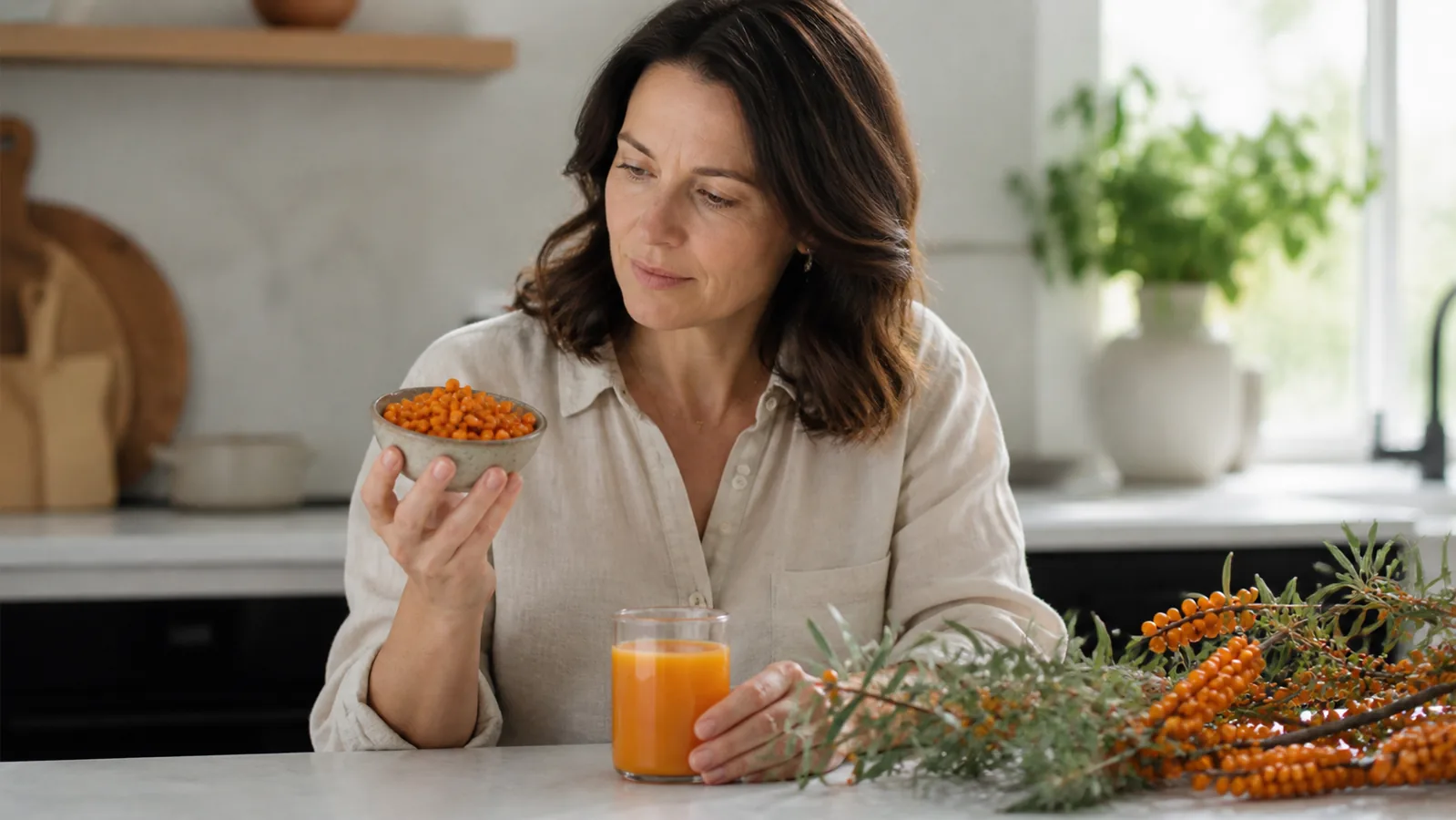
What human studies have examined
Small trials have studied sea buckthorn berries, puree, oils, and extracts for blood lipids, glucose, blood pressure, inflammation, skin, and mucosal symptoms. A meta-analysis reported possible lipid changes, especially in people with abnormal lipid metabolism, but found no overall effect on blood glucose, blood pressure, or BMI. Heterogeneity was high.
What about stress relief?
There is not convincing clinical evidence that sea buckthorn is a direct treatment for stress, anxiety, or high cortisol. A tart berry drink may be enjoyable, but the effect should not be confused with evidence for psychotherapy, movement, sleep care, social support, or indicated medication.
Food versus concentrated products
Whole berries and food products differ from seed oil, pulp oil, and standardized extracts. Doses are not interchangeable. Products may also contain substantial added sugar or make claims that outrun the research.
Safety questions
Human safety data for concentrated long-term use remain limited. Because sea buckthorn may influence platelets, glucose, or blood pressure, discuss extracts with a clinician if you use anticoagulant, antiplatelet, diabetes, or blood-pressure medication. Pregnancy and breastfeeding safety is not established.
Read the product name as carefully as the headline
Sea buckthorn is not a single standardized intervention. A spoonful of fruit puree, a sweetened drink, a seed oil capsule, and a pulp oil capsule contain different mixtures of nutrients and other compounds. An extract may be concentrated or processed in ways that change its composition further. Before applying a study to a product, match the plant species, plant part, preparation, serving, and duration as closely as possible.
This matters when advertisements describe a food as a rich source of a particular vitamin or fatty acid. A nutrient found in berries may not be present in the same amount in an oil. Conversely, an oil may concentrate fats that are not the main feature of a fruit drink. The front label rarely explains these differences. Check the ingredients and nutrition information instead of treating every product with the same berry photograph as equivalent.
What would a convincing health benefit look like?
For a cholesterol claim, look for controlled human trials with comparable participants and a clearly defined lipid outcome. For a skin or mucosal symptom claim, look for a study measuring that symptom rather than borrowing evidence from cardiovascular research. For stress or anxiety, a laboratory mechanism or an animal experiment is not enough. A product needs evidence relevant to the outcome being advertised.
Small trials can identify promising signals, but their results may not repeat in a larger population. Participants may start with a deficiency, an abnormal laboratory value, or a particular condition. An improvement in that group cannot automatically be promised to a healthy person. A review is useful for seeing the whole evidence pattern, including conflicting findings and differences between products, rather than selecting the most impressive individual result.
Use the berry as a food first
The tart flavor can work in a small amount of sauce, yogurt, oats, or a dressing. Taste a little before adding it to an entire recipe. Pairing it with familiar foods is more practical than forcing down a concentrated drink because it sounds medicinal. A food that you enjoy occasionally does not need to become a daily protocol. Other fruits and vegetables can supply a broad range of nutrients without a special ingredient.
For example, stir a small spoonful of an unsweetened puree into plain yogurt with oats, or use it to brighten a dressing for cooked vegetables. These are culinary examples, not therapeutic doses. If you buy a drink, compare the portion you actually pour with the label serving. A product marketed around berries can still be mostly sweetened liquid. Choose it for taste and fit within your overall eating pattern.
Make a supplement decision more specific
Before considering a capsule, write down what you expect it to change. Is the concern a diagnosed condition, an unexplained symptom, or simply fear of missing a longevity trend? Those situations require different responses. A persistent symptom deserves an assessment. A diagnosed condition deserves a treatment plan with meaningful outcomes. A vague promise of optimization is not a strong reason to add an uncertain product.
Take the full label to a clinician or pharmacist, including any combination ingredients. Ask whether evidence exists for that formulation, whether it could interact with current treatment, and how you would know if it helped. Do not use a supplement response as a substitute for blood-pressure monitoring, lipid management, or other recommended care. Product quality testing may help assess manufacturing quality, but it does not demonstrate clinical effectiveness.
Safety is more than a list of possible interactions
Limited evidence about an interaction is not proof that an interaction cannot happen. Equally, a theoretical mechanism should not be presented as a documented clinical effect. This distinction is especially relevant for concentrated botanical products. People taking several medicines should have the entire supplement list reviewed together, because combinations can create problems that are not obvious from one ingredient considered alone.
Stop and seek advice if a new product is followed by persistent digestive symptoms, a rash, unusual bleeding, dizziness, or another concerning change. Severe allergic symptoms require urgent care. During pregnancy or breastfeeding, uncertainty is a reason to ask for individualized guidance rather than borrow a dose from a general wellness article. Ordinary food use and a concentrated extract should remain separate conversations.
Look for marketing shortcuts
Be cautious when a seller uses the presence of antioxidants as proof of an anti-aging outcome. Many ordinary foods contain antioxidant compounds. The chemistry of a substance in a laboratory does not tell us what a person absorbs, how it behaves in the body, or whether it changes illness risk. Similarly, traditional use can explain cultural interest without establishing that a modern capsule treats disease.
A balanced conclusion leaves room for both enjoyment and uncertainty. Sea buckthorn can be an interesting ingredient, while its concentrated products remain an area requiring stronger human evidence. You can apply the same questions to our review of turmeric and heart health: distinguish the food from the supplement, identify the outcome, and keep proven care in the picture.
The Healthspan Muse perspective
Sea buckthorn can be treated like an interesting berry, not a rescue plan. Enjoying it as food is different from expecting a concentrated supplement to solve stress or cardiovascular risk.
For a related practical guide, read Alpha-Ketoglutarate (AKG) Supplements: Promising Science or Longevity Hype?.
Sources
- Sea buckthorn and metabolic-syndrome factors: systematic review and meta-analysis
- Human cardiovascular evidence review
- Sea buckthorn puree randomized trial
This article is educational and is not medical advice.