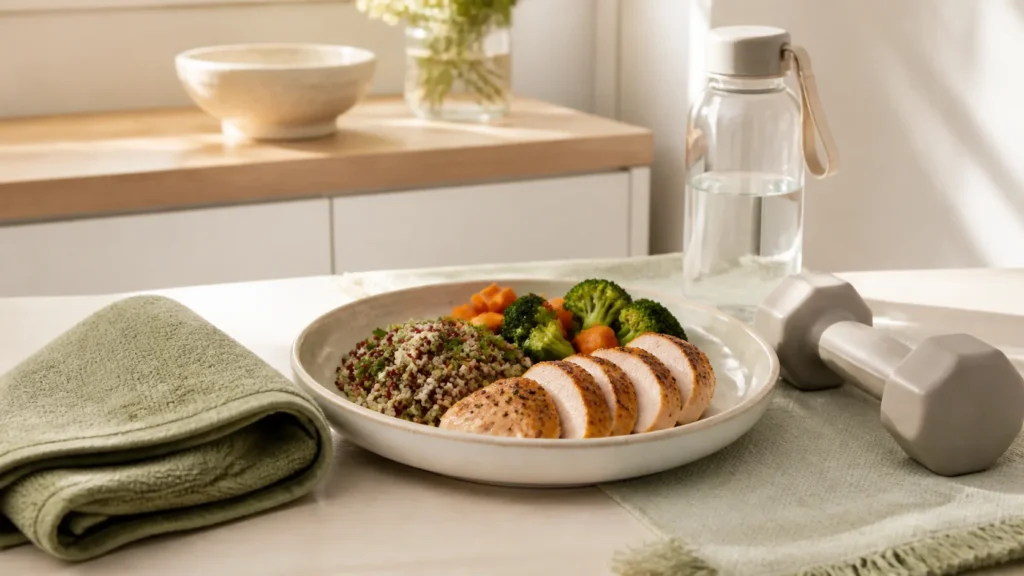
Should you eat protein before or after a workout? Either can support muscle. For most recreational exercisers, the bigger priorities are getting enough protein across the day, training consistently, and choosing timing that feels good during exercise.
What to keep in mind
The useful timing question depends on the last meal, the next meal, digestive comfort, and the training schedule. A short delay does not erase a workout. Daily protein and adequate energy remain central, with individual adjustment for medical needs. Choose food or a convenient shake according to preference and tolerance rather than assuming that a supplement is intrinsically more effective than a meal.
The familiar claim that you must drink a shake within 30 minutes or “waste” your workout turns a useful idea into an unnecessary emergency. Muscle remains responsive to protein for hours after resistance exercise, and a meal eaten before training does not vanish when the workout begins.
What the “Anabolic Window” Really Means
Resistance exercise increases muscle protein synthesis—the process used to repair and remodel muscle proteins. Eating protein supplies the amino acids needed for that work. The two signals complement each other.
Timing can matter, but the window is better pictured as a broad opportunity than a trapdoor. Research comparing tightly timed protein with protein eaten at other times often finds that differences shrink when total daily protein intake is similar. In other words, a perfectly timed shake cannot rescue a day that is consistently low in protein.
When Protein Before Training Makes Sense
A pre-workout meal is useful when several hours have passed since you last ate or when fasted training leaves you weak, distracted, or extremely hungry afterward. Protein consumed one to three hours before exercise continues to be digested and absorbed during and after the session.
Comfort matters. A large, high-fat meal immediately before vigorous exercise may feel heavy. Choose a smaller, familiar option when training is close.
- Greek yogurt with fruit
- Eggs with toast
- A small turkey sandwich
- Fortified soy milk and a banana
- Tofu with a modest serving of rice
When Protein After Training Makes Sense
Post-workout protein is especially practical when you trained after a long period without food, exercised early in the morning, or finish near a normal meal. Eating within a couple of hours is a reasonable habit; there is rarely a need to abandon the shower and sprint toward the blender.
- A regular dinner with fish, chicken, beans, or tofu
- Yogurt, milk, or fortified soy milk
- Cottage cheese and fruit
- Lentil soup with whole-grain bread
- A simple shake when a meal is not convenient
How Much Protein Around a Workout?
A meal containing roughly 20–40 grams of high-quality protein works for many adults, but that is a flexible range rather than a rule. Body size, age, training volume, food preferences, and total daily intake all influence the useful amount.
Larger people and some older adults may benefit from the upper portion of that range. Smaller adults may need less. The meal does not have to contain an exact number, and consuming 60 grams at once is not automatically superior to a satisfying balanced meal.
Total Daily Protein Comes First
Meta-analyses of resistance-training studies suggest that protein supplementation can modestly improve gains in lean mass and strength when it helps people meet an adequate intake. Benefits appear to level off rather than increasing without limit.
For generally healthy adults who train, many sports-nutrition frameworks use approximately 1.2–1.6 grams per kilogram per day, depending on goals and circumstances. This is not appropriate for everyone and should not override advice for kidney disease or other medical conditions.
Instead of concentrating nearly all protein at dinner, include a meaningful source at breakfast, lunch, and dinner. Distribution does not need to be mathematically perfect; it simply avoids a pattern of very little protein all day followed by one enormous serving.
What Changes for Adults Over 40?
Aging muscle may respond less strongly to a small protein dose, a phenomenon sometimes described as anabolic resistance. Resistance exercise helps sensitize muscle to amino acids. Regular protein-containing meals and progressive training therefore become more—not less—valuable with age.
A randomized trial in postmenopausal women found no additional improvement in lean mass, strength, or function from taking protein immediately before versus immediately after resistance training when the broader program was controlled. That does not prove timing never matters, but it argues against treating one side of the workout as uniquely magical.
What If You Train Early and Do Not Like Breakfast?
You can train without eating if you feel well and your medical situation allows it. Plan a protein-containing breakfast afterward. If fasted training causes dizziness, poor performance, nausea, or intense rebound hunger, try a small snack such as milk, soy milk, yogurt, or half a sandwich before exercise.
People using glucose-lowering medication should ask their clinician how to fuel and monitor exercise. Symptoms of low blood sugar need appropriate treatment, not a protein-timing experiment.
Plant-Based Protein Around Exercise
Plant-based athletes can build and maintain muscle. Soy foods, beans, lentils, peas, seitan, nuts, seeds, and whole grains all contribute. Because many plant foods provide less protein per serving and have different amino-acid profiles, slightly larger portions or complementary foods may help.
You do not need to combine specific plant proteins at every bite. Eating a varied diet across the day is generally sufficient. A soy- or pea-based protein powder can be convenient, but it is optional.
Do You Need Carbohydrates Too?
Carbohydrates support training energy and replenish glycogen, particularly after long, high-volume, or repeated sessions. A balanced meal containing both protein and carbohydrate is often more useful than protein alone. Think yogurt and fruit, eggs and toast, tofu and rice, or chicken and potatoes.
Common Timing Mistakes
- Obsessing over minutes while total daily protein remains low.
- Using a large shake that crowds out vegetables, fiber, and regular meals.
- Eating a heavy meal too close to exercise and blaming the workout for discomfort.
- Assuming more powder produces more muscle without progressive training.
- Ignoring kidney disease, appetite problems, or medication-related nutrition needs.
Frequently Asked Questions
Is a protein shake better than food after a workout?
No. A shake is faster and portable, but a normal meal can provide protein just as effectively while adding other nutrients.
How long after training can I wait?
If you ate protein in the few hours before training, your next normal meal is usually fine. If you trained after a long fast, eating within roughly two hours is a practical approach.
Does protein timing matter more for serious athletes?
It may matter more when sessions are very frequent, total intake is tightly managed, or rapid recovery is required. Even then, daily intake and training quality remain foundational.
The Bottom Line
Protein before and after a workout can both support muscle. Place a protein-rich meal reasonably close to training on whichever side best suits your schedule and digestion. Unless you are training under specialized performance demands, consistency across the day matters more than winning a race against the clock.
For a related practical guide, read High-Protein Breakfasts for Healthy Aging.
Sources
- Protein timing and muscle strength and hypertrophy: meta-analysis
- Protein supplementation and resistance-training adaptations: systematic review and meta-analysis
- Protein timing in postmenopausal women: randomized clinical trial
This article is for educational purposes and does not replace individualized medical or nutrition advice.